I have a soft spot for small websites.
The kind that seem to have been made because one person had an idea and thought, “I wonder if I can make this.”
They usually do one thing. Sometimes they do almost nothing. There might be a big button in the middle of the page, a strange animation, a collection of links, a game that makes no sense, or just something you can sit and play with for a few minutes.
And for some reason, I often remember these websites more than I remember much bigger ones.
I think part of it is that you can feel the person behind them.
A lot of websites today are built to do everything. Read something. Watch something. Buy something. Subscribe. Make an account. Follow someone. Get recommended something else. They can be very useful, and I use plenty of them myself.
But sometimes I don’t want a website to do everything. Sometimes I just want it to be a little weird.
One of the things I like about small websites is that they have a very clear idea behind them. You understand what the site is almost immediately, and then you’re free to explore it.
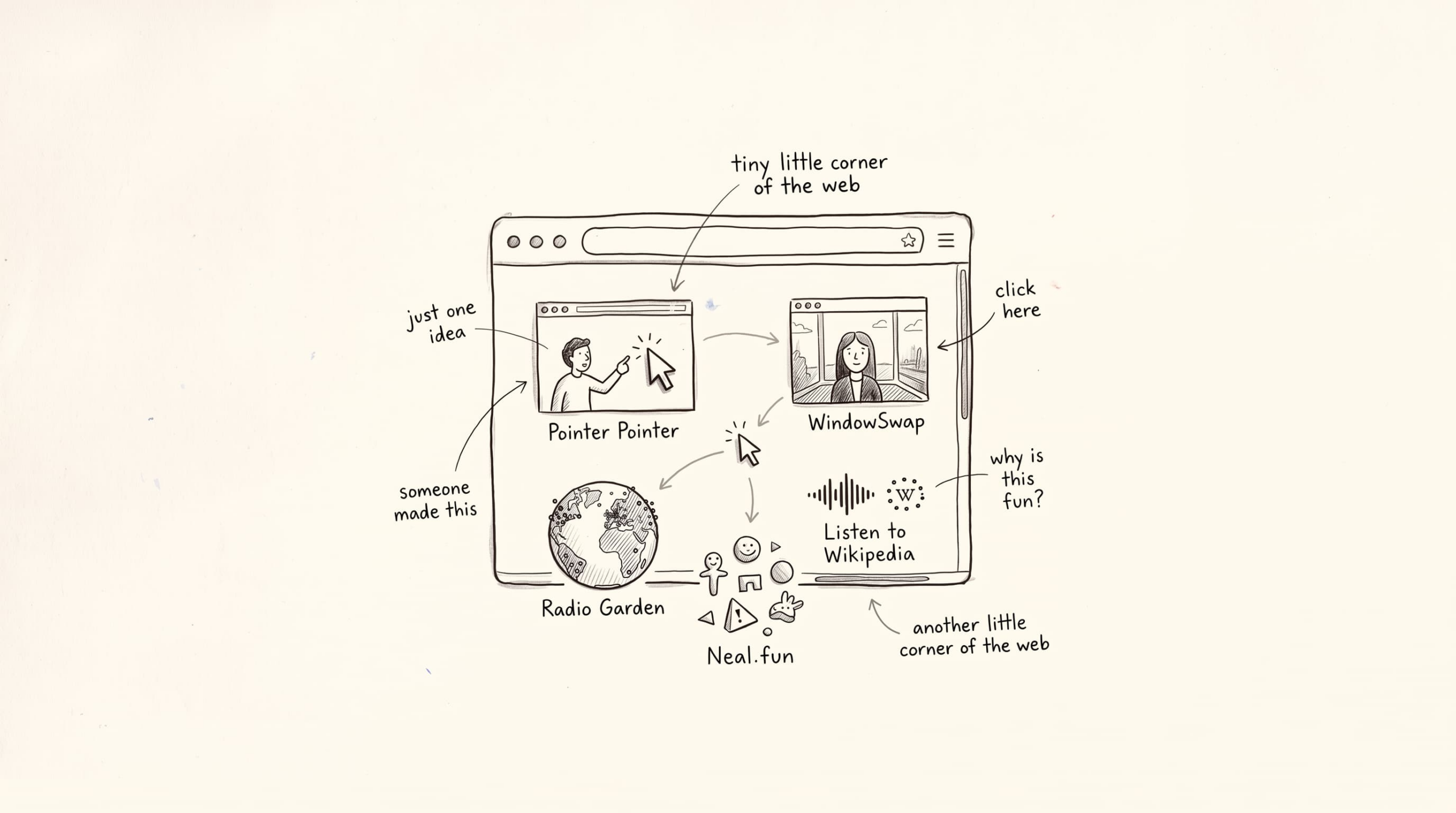
Take Pointer Pointer.
The idea is completely ridiculous. Move your cursor somewhere on the page and, after a moment, the site finds a photograph of someone pointing directly at where your cursor is. That’s basically the whole thing, and there’s no deeper purpose to it. I think that’s exactly why it works.
It’s one of those tiny websites where you try it once, laugh a little, and then move your cursor somewhere else just to see if it can possibly find another person pointing there. I like that kind of website.
It doesn’t need to convince you to stay for two hours. It doesn’t need a complicated dashboard. It doesn’t need to explain itself with five paragraphs of text.
It just gives you one little thing to do.
WindowSwap takes a different idea and makes it into a website.
During the lockdowns of 2020, the creators built a site where you could look through a stranger’s window somewhere else in the world. The videos were fixed views, usually around ten minutes long, with the ordinary sounds of the place. There were no likes, comments or follower counts getting in the way.
I find that much more interesting than it probably sounds on paper. There is something nice about clicking a button and suddenly seeing a completely ordinary view from somewhere else. Not a famous landmark. Not a carefully edited travel video. Just someone’s window. That’s the sort of thing I mean when I say small websites feel different. They don’t always seem to be asking for something from you.
Then there is neal.fun, which is probably one of the best examples of this whole idea.
It’s basically a collection of strange little interactive things made by Neal Agarwal. You can scroll through visual experiments, play odd games, explore enormous scales, mess around with puzzles and find all sorts of other distractions. There’s no need to create an account or sit through some elaborate onboarding process before you can start playing.
I like the fact that it feels more like opening a drawer full of interesting objects than visiting a traditional website. You don’t necessarily arrive with a goal. You just start clicking.
That matters to me because so much of the web is built around the idea that every visit should lead somewhere. Buy this. Read that. Watch this next. Stay a little longer.
A website like neal.fun can simply let you wander around.
Radio Garden does something similar, although in a completely different way. Instead of giving you a list of radio stations, it lets you move around a globe and pick up live radio from different places. The geography becomes the interface.
I think that’s a beautiful use of a website. You are not really browsing a database. You are travelling around it.
And then there is Listen to Wikipedia, which turns live Wikipedia edits into sounds and visual bubbles. Changes to Wikipedia become something you can watch and hear happening in real time.
I don’t know that I have any practical reason to use a website like that. That’s partly why I like it. It exists because somebody thought the idea was interesting enough to build.
I think that’s one of the things I miss when people talk about websites only as products. A website can also be a small experiment, a toy, an odd little corner of the internet that somebody made because they were curious.
And I don’t think this means the old internet was automatically better.
There were plenty of terrible websites. There were broken layouts, annoying popups, slow pages, ugly designs and things that were difficult to use for no good reason. I don’t want to pretend every tiny website from the past was some magical piece of art.
For me it isn’t really about old versus new. It comes down to intention, and a small website usually has less standing between you and the idea.
I think that’s true for most of these sites. The idea is immediately understandable, and the limits are part of what makes them fun. The site gives you one thing, puts a few boundaries around it, and lets the idea carry the rest.
That makes sense to me.
Maybe this is also why I enjoy making my own little websites.
I’m not trying to build the next big platform with Unheard.me. I don’t really have any interest in that.
I like the thought of having a small place on the web where I can write something, build something strange, collect things I like, try an idea, or put up a page just because I wanted to see what it looked like.
There is something satisfying about making a thing that does not need to scale to millions of people to be worth making.
Maybe ten people find it.
Maybe a hundred.
Maybe nobody does.
You can still make it.
That is probably the part of small websites I find most interesting. They remind me that the web can still be a place for curiosity.
You can make one because you have an idea, because you’re bored, because you want to learn how something works, or because you found something interesting and wanted to put it somewhere.
And sometimes you make one that does almost nothing at all.
Those are often the ones I end up remembering.

Leave a Reply